
socinvest@rambler.ru
Пишите
Maxim Nikulin:
“There are two planets — one is the planet of people, the other is the planet Circus”
INTERVIEW · ARTEL MAGAZINE
Maxim Nikulin grew up in the circus and became a journalist — yet he came back, taking the helm of the Circus on Tsvetnoy Boulevard. On two planets: the planet of people and the planet Circus.
Maxim Nikulin grew up in the circus and became a journalist — yet he came back, taking the helm of the Circus on Tsvetnoy Boulevard. On two planets: the planet of people and the planet Circus.
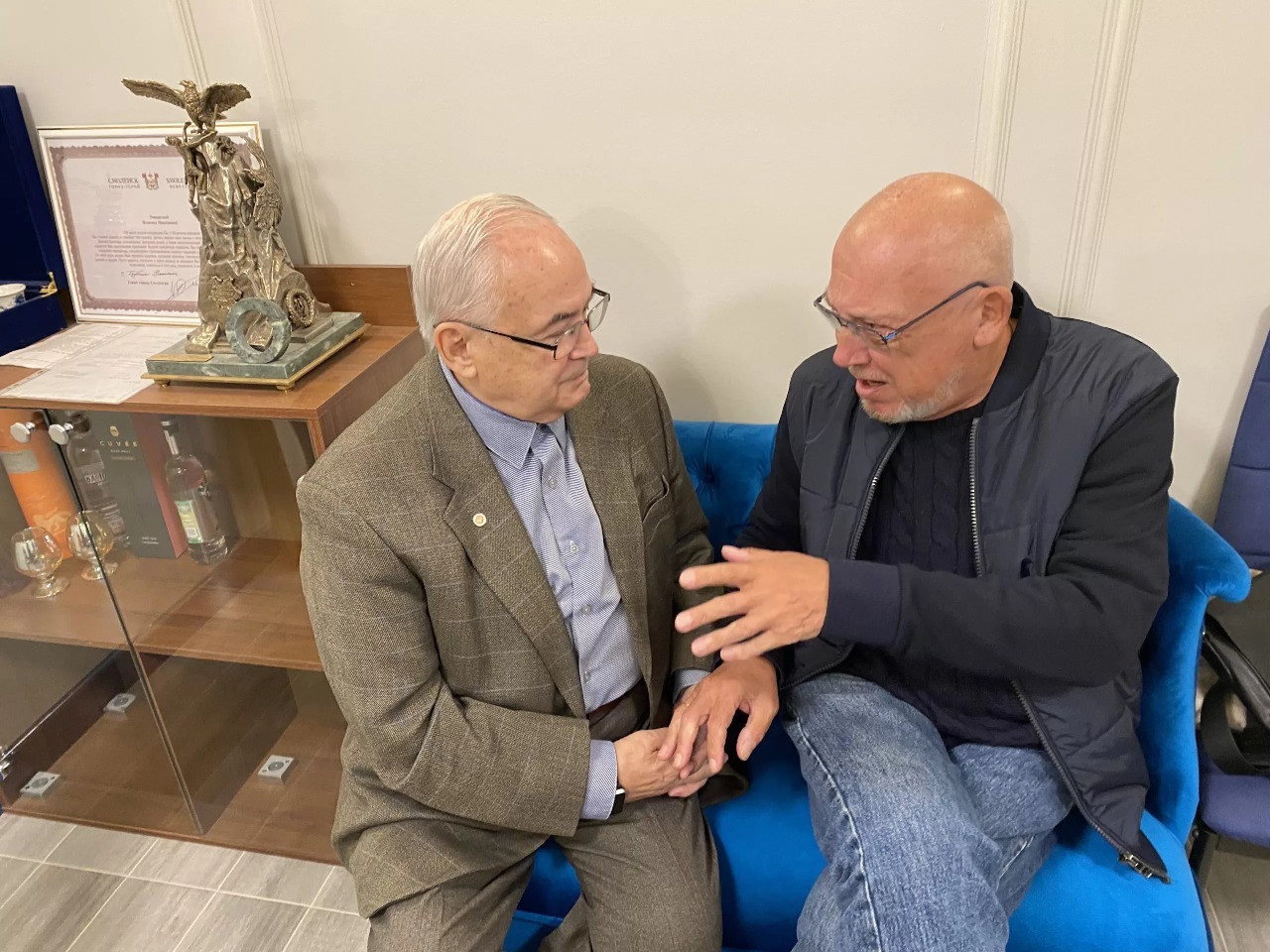
He grew up in the circus. Yet he did not become a performer and took a different path — journalism was what interested him. After graduating from Moscow State University, he worked at Moskovsky Komsomolets and at Mayak radio, and hosted the TV program Utro (now Dobroe Utro). Gradually, though, Maxim kept finding his way back to the circus: he hosted a program about the circus on the Kultura channel and helped his father set up the Circus and Charity foundation. Later, after Yuri Vladimirovich passed away, Maxim became general director and artistic director of the Circus on Tsvetnoy Boulevard and an academician of the National Academy of Circus Arts. For the Social Investments non-profit partnership, a winner of the second Presidential Foundation for Cultural Initiatives competition in 2023, Maxim Nikulin’s foundation became a partner in producing the short feature film The Old Clown.
— Maxim, what is the circus?
— I had a friend, a Frenchman, Pierrot Bidon; he died very young. Pierrot staged a show for us on Tsvetnoy and called it Planet Circus. He invited performers from Europe, Mexico, Brazil, America and Russia. At the press conference before the premiere he was asked: with this title, did you want to show that performers from all over the Earth have gathered in Moscow? He replied: “I meant something quite different — there are two planets. One is the planet of people. And the other, a little one, is the planet Circus. On the big planet there are always wars, betrayal, treachery, murders, earthquakes and disasters, while on the little planet everyone works together, regardless of nationality, religion or skin color.”
That’s true: in the circus there is one nationality — performer, and one god — the ring, to which everyone prays. There it doesn’t matter what color your skin is; what matters is that you can do something. There are no drugs and no alcoholism — you physically can’t survive with that; it’s a given of the profession. Children in the circus grow up faster. Yes, they have fewer childhood joys than children in the rest of the world, but they grow up with something laid down in their minds, in their subconscious. Many people on the “big planet” lack this trait — responsibility for someone else’s life. It doesn’t matter what form that responsibility takes: the shoulders your partner stands on, or the hand grip with which you hold your partner or your partner holds you.
— Do performers’ characters depend on their circus professions?
— Character is a person’s destiny. It can divide people, whereas the profession of circus performer unites them. By the way, in our understanding a “circus person” is not necessarily someone connected with the circus. A “circus person” shows in their attitude to life and to other people, in their responsibility to themselves and for others. They are marked by openness, decency and a desire to help and support. My children are 100% circus people, which is why they work in the circus. I didn’t work in the circus — I grew up in it. The circus world is easy to enter, it is hospitable, but sometimes this parallel world does not accept a person. I knew people who thought they wanted to work in the circus, but they didn’t find a place there, didn’t find themselves. Yes, it’s a unique world.
— The generation of the Soviet circus and theater school is passing. Yet many of them can still create, perform and tell stories. How do veterans live on “planet Circus”?
— In the life of the circus we make a point of involving different generations. Many people who can no longer work in their specialty — because of old age or lack of physical strength — still stay in the circus. Almost all our ushers used to be in our ballet troupe. There are former performers in the fire service too. Many performers pass their acts on to their children and go on to work as their assistants. It’s a very open and at the same time very strange world — these 13 meters.
When my father and I set up the Circus and Charity Foundation, our aim was simply to support circus performers who were retiring. Circus veterans living on pensions worth kopecks, with their occupational ailments, needed support — above all financial, because these were the 1990s and then the 2000s, sheer horror and nightmare. And unexpectedly our Foundation turned into a club. Many veterans, who found it hard even to leave home to get help, came to us and stayed at the Foundation until evening. They drank tea, chatted and reminisced. These people had spent their whole lives in a troupe, surrounded by friends and colleagues. They all shared one life, and suddenly it ends. This companionship may matter more than the money, medicines, hospitals and doctors we helped them with. No medicine can replace such companionship.
— Can they still be useful beyond working as ushers and firefighters?
— We gather veterans for special occasions, for example on 9 May. We invite them to premieres and run-throughs, and some of them give tours at our Foundation. For example, veteran clowns tell stories and show little gags. Many former circus performers teach at the circus school.
— Maxim, what is the circus?
— I had a friend, a Frenchman, Pierrot Bidon; he died very young. Pierrot staged a show for us on Tsvetnoy and called it Planet Circus. He invited performers from Europe, Mexico, Brazil, America and Russia. At the press conference before the premiere he was asked: with this title, did you want to show that performers from all over the Earth have gathered in Moscow? He replied: “I meant something quite different — there are two planets. One is the planet of people. And the other, a little one, is the planet Circus. On the big planet there are always wars, betrayal, treachery, murders, earthquakes and disasters, while on the little planet everyone works together, regardless of nationality, religion or skin color.”
That’s true: in the circus there is one nationality — performer, and one god — the ring, to which everyone prays. There it doesn’t matter what color your skin is; what matters is that you can do something. There are no drugs and no alcoholism — you physically can’t survive with that; it’s a given of the profession. Children in the circus grow up faster. Yes, they have fewer childhood joys than children in the rest of the world, but they grow up with something laid down in their minds, in their subconscious. Many people on the “big planet” lack this trait — responsibility for someone else’s life. It doesn’t matter what form that responsibility takes: the shoulders your partner stands on, or the hand grip with which you hold your partner or your partner holds you.
— Do performers’ characters depend on their circus professions?
— Character is a person’s destiny. It can divide people, whereas the profession of circus performer unites them. By the way, in our understanding a “circus person” is not necessarily someone connected with the circus. A “circus person” shows in their attitude to life and to other people, in their responsibility to themselves and for others. They are marked by openness, decency and a desire to help and support. My children are 100% circus people, which is why they work in the circus. I didn’t work in the circus — I grew up in it. The circus world is easy to enter, it is hospitable, but sometimes this parallel world does not accept a person. I knew people who thought they wanted to work in the circus, but they didn’t find a place there, didn’t find themselves. Yes, it’s a unique world.
— The generation of the Soviet circus and theater school is passing. Yet many of them can still create, perform and tell stories. How do veterans live on “planet Circus”?
— In the life of the circus we make a point of involving different generations. Many people who can no longer work in their specialty — because of old age or lack of physical strength — still stay in the circus. Almost all our ushers used to be in our ballet troupe. There are former performers in the fire service too. Many performers pass their acts on to their children and go on to work as their assistants. It’s a very open and at the same time very strange world — these 13 meters.
When my father and I set up the Circus and Charity Foundation, our aim was simply to support circus performers who were retiring. Circus veterans living on pensions worth kopecks, with their occupational ailments, needed support — above all financial, because these were the 1990s and then the 2000s, sheer horror and nightmare. And unexpectedly our Foundation turned into a club. Many veterans, who found it hard even to leave home to get help, came to us and stayed at the Foundation until evening. They drank tea, chatted and reminisced. These people had spent their whole lives in a troupe, surrounded by friends and colleagues. They all shared one life, and suddenly it ends. This companionship may matter more than the money, medicines, hospitals and doctors we helped them with. No medicine can replace such companionship.
— Can they still be useful beyond working as ushers and firefighters?
— We gather veterans for special occasions, for example on 9 May. We invite them to premieres and run-throughs, and some of them give tours at our Foundation. For example, veteran clowns tell stories and show little gags. Many former circus performers teach at the circus school.
“
In the circus there is one nationality — performer, and one god — the ring, to which everyone prays.
— Maxim, what is a clown?
— A clown is a state of mind, a philosophy. As clowns say, people don’t laugh at a clown, they laugh with him. Not everyone can allow others to laugh at them. It’s a particular character trait. Clowning is the only discipline in the circus that isn’t taught. You either are a clown or you aren’t. It’s something given by God, from childhood, from birth.
To be a clown you need a great many ingredients. You can train a person to be a gymnast, an equilibrist or a juggler — but how do you train someone to be a clown? The most important thing is that a person must have a dream. Practically all the clowns I have known and know dreamed of it since childhood. The dream has to live in a person for a certain number of years and not leave them. There are no young clowns. A person has to understand something about life and gain experience. In childhood or youth that’s impossible; something has to settle inside. The stars have to align for that dream to come true.
— So for Yuri Vladimirovich the stars aligned and his childhood dream came true?
— Yes. My father had an acquaintance who had nothing to do with the circus — he managed a shop that sold mineral water. My father used to chat with him and bought water from him after his ulcer. Once we were sitting with him in the back, in the little buffet; he was joking around — a joker, cheerful, a front-line veteran too, by the way. And my father said to him: with your build, your attitude to life, the way you move and tell stories, you could have been a clown. He turned deathly pale and said: Yuri Vladimirovich, that was the greatest dream of my life. But it didn’t work out — you see, the stars didn’t align. A clown is a great rarity.
There’s a song called “Take Care of the Clowns”. They are in short supply all over the world. There are few of them, they are all different, and they can’t be compared. If you counted all the clowns in the world today, the fingers of one hand would be enough.
— How did Yuri Nikulin come up with his acts?
— Most things were taken from life. Once he saw a cartoon in Krokodil magazine: a man at a market holding a watermelon in one hand and a weight in the other, weighing it. The caption read: “When there are no scales”. And so the gag “The Scales” was born. The funniest gag of all, a classic of the genre, is the one with the log. My father and Evstigneev were filming Ryazanov’s Old Men: Robbers. There was an episode where they steal a painting from a museum. They filmed in a real museum, and the painting was real and heavy. They’d shoot a take — then “cut, back to the start”, and they’d drag it back again. On the fifth or sixth take Evstigneev says: “Yura, why are we lugging it around and straining ourselves? We’re old men already.” They went up to Ryazanov and said: “Elik, why are we the ones doing the lugging?” Ryazanov said: true enough, there are stagehands for that — why are you fooling around here? That’s how that gag came about. All the gags he did with Mikhail Shuydin were their own, because they made them to fit themselves.
There was a wonderful clown, Semyon Margulyan, long since retired. Semyon considered himself Nikulin’s pupil. My father met him and said: there are 60 gags, take them, I don’t mind. It didn’t work for Semyon — the character wasn’t his, nor the tempo and rhythm, nor the movement. It came out unfunny. My father compared gags to jokes: they are like little pebbles polished by water — a mosaic. Jokes get retold; something is added, something falls away. That’s how a classic is born.
— What kind of clowns do you have now? Seasoned people, then? With life experience…
— Among other things, these days we invite clowns we know and trust to the circus. Our circus has its own style. And the main thing is that it all fits our building blocks, our mosaic — not only the clowns but the acts too. We know our audience: what they might like, what to offer them, what new things to show — though not all at once either. New things put people off. Everyone knows people are wary of the new. You have to move forward very carefully. We don’t push people towards ideas or meanings, and we don’t scare them; we try to lead them there gently.
— A clown is a state of mind, a philosophy. As clowns say, people don’t laugh at a clown, they laugh with him. Not everyone can allow others to laugh at them. It’s a particular character trait. Clowning is the only discipline in the circus that isn’t taught. You either are a clown or you aren’t. It’s something given by God, from childhood, from birth.
To be a clown you need a great many ingredients. You can train a person to be a gymnast, an equilibrist or a juggler — but how do you train someone to be a clown? The most important thing is that a person must have a dream. Practically all the clowns I have known and know dreamed of it since childhood. The dream has to live in a person for a certain number of years and not leave them. There are no young clowns. A person has to understand something about life and gain experience. In childhood or youth that’s impossible; something has to settle inside. The stars have to align for that dream to come true.
— So for Yuri Vladimirovich the stars aligned and his childhood dream came true?
— Yes. My father had an acquaintance who had nothing to do with the circus — he managed a shop that sold mineral water. My father used to chat with him and bought water from him after his ulcer. Once we were sitting with him in the back, in the little buffet; he was joking around — a joker, cheerful, a front-line veteran too, by the way. And my father said to him: with your build, your attitude to life, the way you move and tell stories, you could have been a clown. He turned deathly pale and said: Yuri Vladimirovich, that was the greatest dream of my life. But it didn’t work out — you see, the stars didn’t align. A clown is a great rarity.
There’s a song called “Take Care of the Clowns”. They are in short supply all over the world. There are few of them, they are all different, and they can’t be compared. If you counted all the clowns in the world today, the fingers of one hand would be enough.
— How did Yuri Nikulin come up with his acts?
— Most things were taken from life. Once he saw a cartoon in Krokodil magazine: a man at a market holding a watermelon in one hand and a weight in the other, weighing it. The caption read: “When there are no scales”. And so the gag “The Scales” was born. The funniest gag of all, a classic of the genre, is the one with the log. My father and Evstigneev were filming Ryazanov’s Old Men: Robbers. There was an episode where they steal a painting from a museum. They filmed in a real museum, and the painting was real and heavy. They’d shoot a take — then “cut, back to the start”, and they’d drag it back again. On the fifth or sixth take Evstigneev says: “Yura, why are we lugging it around and straining ourselves? We’re old men already.” They went up to Ryazanov and said: “Elik, why are we the ones doing the lugging?” Ryazanov said: true enough, there are stagehands for that — why are you fooling around here? That’s how that gag came about. All the gags he did with Mikhail Shuydin were their own, because they made them to fit themselves.
There was a wonderful clown, Semyon Margulyan, long since retired. Semyon considered himself Nikulin’s pupil. My father met him and said: there are 60 gags, take them, I don’t mind. It didn’t work for Semyon — the character wasn’t his, nor the tempo and rhythm, nor the movement. It came out unfunny. My father compared gags to jokes: they are like little pebbles polished by water — a mosaic. Jokes get retold; something is added, something falls away. That’s how a classic is born.
— What kind of clowns do you have now? Seasoned people, then? With life experience…
— Among other things, these days we invite clowns we know and trust to the circus. Our circus has its own style. And the main thing is that it all fits our building blocks, our mosaic — not only the clowns but the acts too. We know our audience: what they might like, what to offer them, what new things to show — though not all at once either. New things put people off. Everyone knows people are wary of the new. You have to move forward very carefully. We don’t push people towards ideas or meanings, and we don’t scare them; we try to lead them there gently.